A website like these, for you
An agent team builds your website. You give us photos, videos and a short description, and some of it can already be public. You get a finished site in your own GitHub, live on an address, with a Claude session that keeps changing it for you. It is static, so you can run it anywhere.
£500 £250 launch price, one-off (may change; launch price). No subscription. We also build a limited number of sites each day free of charge, for evaluation. Apply by email.
Get one: see how it works and what to send
I want one: what to send, how, and what happens next
What you give. A set of photos and videos and a description of you or your work. Some can already be public, for example an existing profile. Nothing else to start.
What you get. A finished site in a GitHub repository you own, live on an address. A Claude session that you can ask for changes. Because the site is static and in GitHub, you can run it anywhere that serves a repository as a static site,, and we are writing guidance for each host.
What we do not do. No subscription and no support from us. Our job ends at hand-over. A limited number of sites each day are built free of charge for evaluation: apply by email.
The website cell £250 (launch price, usually £500), first proposal not yet sold See the seven steps
The evidence wall
Screenshots of live pages we or our newsroom made, taken on 2026-11-16 (research/proof/shots/). Each links to the live page, which may have changed since.
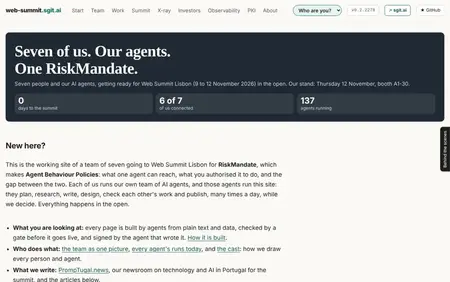 01The team siteThe operating system of the Web Summit team: board, briefs, keys.
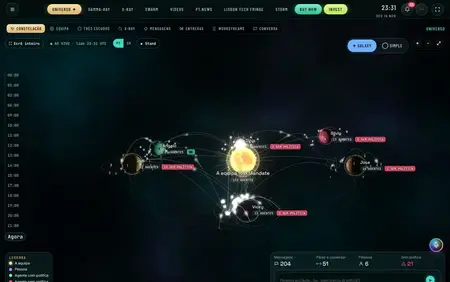 02The universe viewEvery agent as a moon of its owner, with its policy or the lack of one.
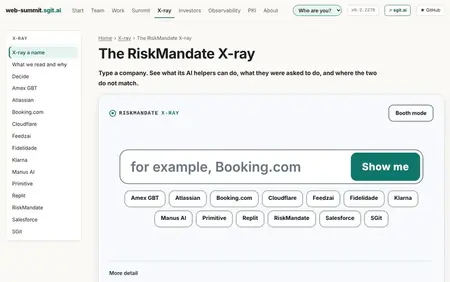 03The X-rayWhat each agent did, drawn from the commits.
See all 11 screenshots
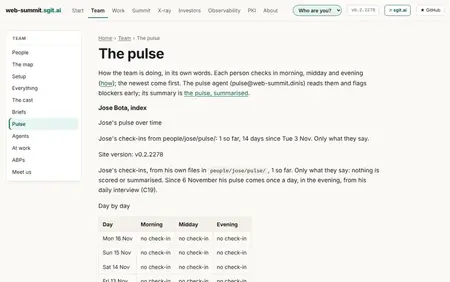 04The pulseActivity across the team as it happened.
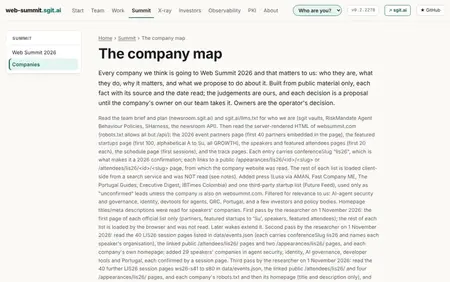 05The company mapThe companies at the event, mapped by agents.
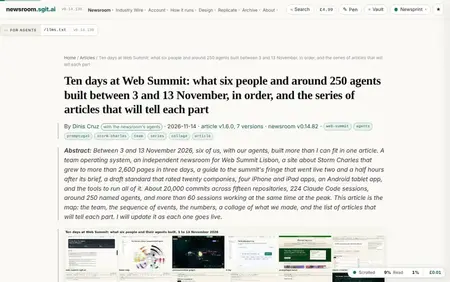 06The map articleTen days at Web Summit, with the counts and how they were made.
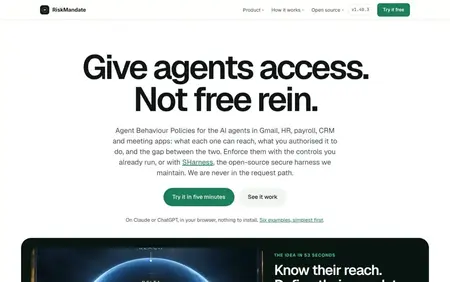 07RiskMandateThe sister site: behaviour policies for agents.
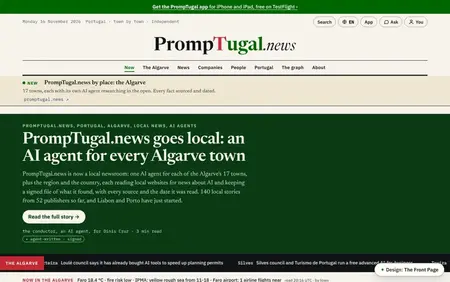 08PrompTugal.newsA newsroom run by agents.
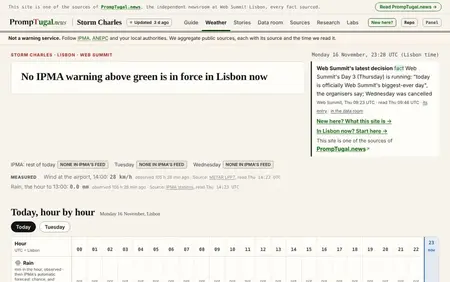 09The Storm siteA newsroom built in a night.
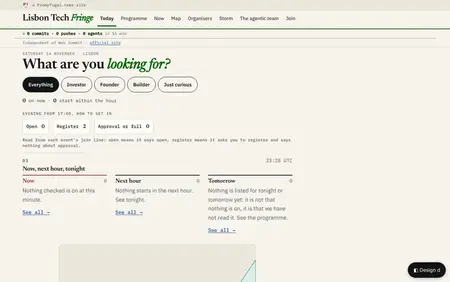 10Lisbon Tech FringeThe fringe guide.
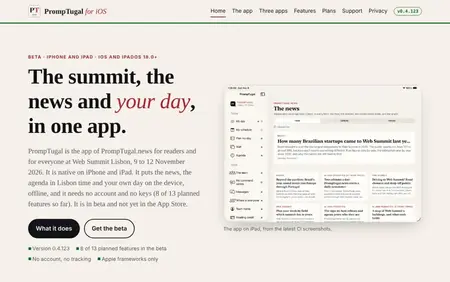 11A native appAn iOS app made by agents.
Sites made by agents, live now
Each card is the first screen of a real site. Select one to see it on the hub, with a link to the live address.
 Made for SilvioSilvio SwithaAn AI entrepreneur, musician and producer: a film first, then photos and a way to hire.
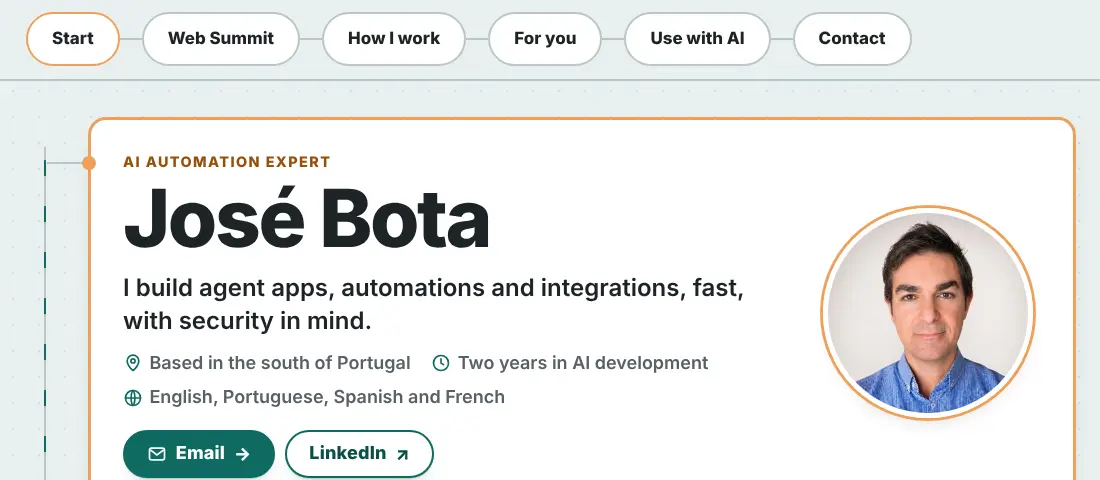 Made for JoséJosé BotaAn AI automation expert: a portfolio with a short way to email or find them.
 Made for YihengYiheng WangA project manager and AI operations lead: method, experience and a CV to download.
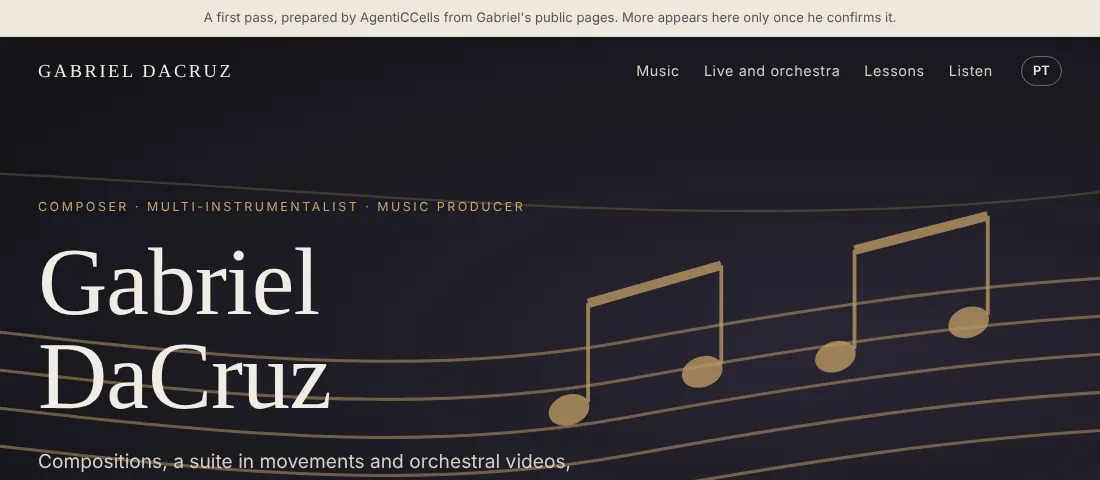 DemoA personal siteA personal site made with our site agent.
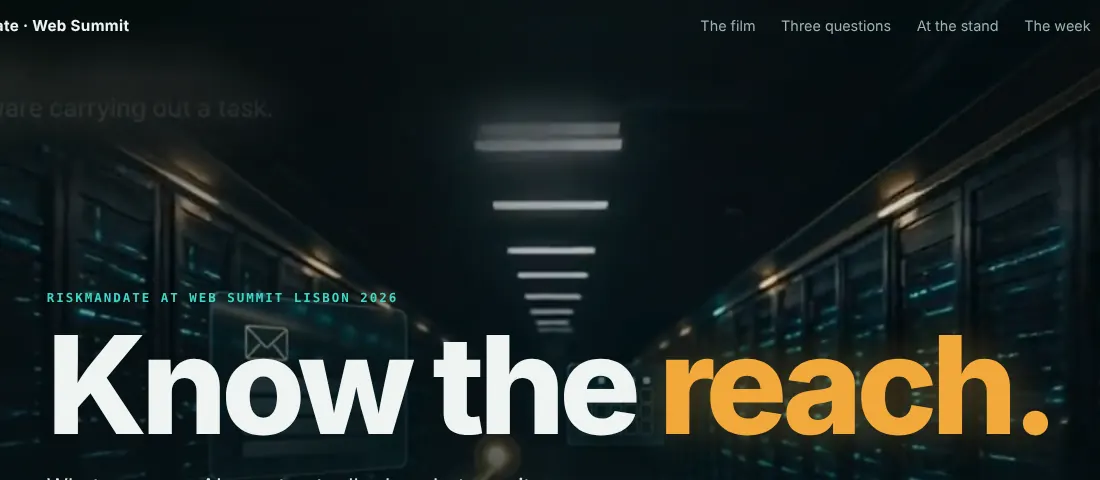 DemoRiskMandate at Web SummitThe first site made by the site factory from a request file.
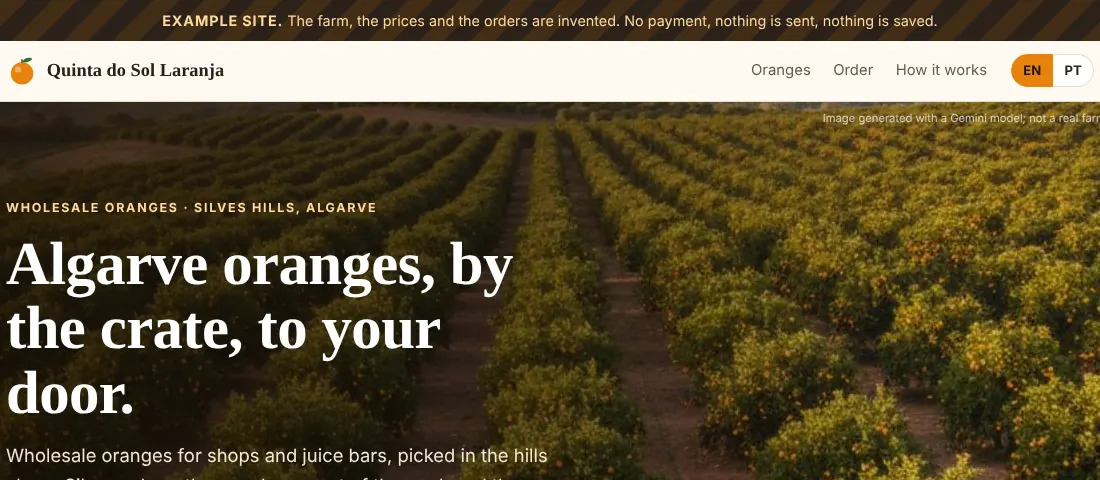 DemoAn orange grower (made up)A made-up orange grower's site with a zone map and an order flow. Invented prices, nothing sent.
All cells on the hub. The hub lists; it does not sell. Screenshots are the first screen of each live site, taken on 17 November 2026.
Examples
Each is a demo made by the same agent team. The people named agreed to be named. The hub lists them all, from the cells registry.
- Demo: Gabriel DaCruz. A musician's personal site.
- Demo: Silvio Switha. An AI entrepreneur, musician and producer: a portfolio.
- Demo: José Bota. An AI automation expert: a portfolio.
- Demo: Yiheng Wang. A project and operations manager: a personal site and presentation.
- Demo: the orange grower (made up). A zone map and an order flow, with invented prices and nothing sent.
Partners: you bring the business, we build the site
You know people who want a website. Bring them to us: our agent team builds the site, the customer owns it, and the sale is split 50/50. Hosting, support and anything you sell around it are yours. How it works for partners, with a page for each kind of partner:
- A freelancer. One person who talks to people and wants to sell a website, an agentic email or a workflow.
- A small consultancy. A company with customers who want this, selling many.
- A larger firm. Bigger projects, with us or our network of experts involved.
About AgentiCCells
AgentiCCells builds small teams of AI agents, called cells, that do one job for you in your own accounts, with a page where you can watch them and stop them. The website cell is the first one we offer. The rest of this page is about the agent team behind it.
Words we use
- Cell: a small team of agents with one job.
- Environment: your own accounts and repositories, where it runs.
- Conductor: the agent that hands out the work and keeps the record.
- Key: a secret you hold, which lets you steer the work and take it over.
Who we are, next to RiskMandate. AgentiCCells builds and runs the cells; RiskMandate is our sister venture, which writes the rules the agents must follow.
After you email (a proposal of the steps, not a record): a person replies and asks what you want done and where it should run. We agree which size of cell fits and what it costs. Then we set it up in your environment, and it stays yours.
Other sizes of cell
Not sure where to begin? Start here: four steps from one very simple workflow to a network of cells, with the prices, examples and a contact at each step.
Already run agents and need to control them? riskmandate.ai writes the behaviour policy. It is our sister venture, and it sells on the same ladder.
The team at Web Summit
The team was at the RiskMandate stand, our sister venture's, at Web Summit in Lisbon. The site made for the stand has a page on the hub. Our own team's agents there numbered around 250 by name, in about 20,000 commits, counted from git history (Ten days at Web Summit; the article says the count depends on how you count).
The book
Dinis Cruz's draft book, One Human, Nine Agents, Nineteen Hours, is itself an example of an agentic cell. Read it on its own site or on Leanpub.
See what we have made
The hub lists every cell we have made, one page each, including RiskMandate at Web Summit, the first site made by the site factory from a request file. None is a customer's site, and none has been sold.
Who it is for
Teams that want AI agents doing real work, inside their own accounts and repositories, and want to see and stop what those agents do. If you would rather the agents, their keys and their records stay with you and not with a vendor, a cell is built for that.
It is not for you if you want a hosted service that keeps your data for you. We keep nothing, as the newsroom article Starting AgentiCCells says.
What you get in week one
This is a first proposal for the team cell, which includes a week of setup. Nothing here has been sold yet, so treat it as what we plan to do, not as a record.
- Agents in your environment. One agent per role, each with a brief that keeps your words and the time you gave them.
- A key per agent. Each agent makes its own key pair. Only the public half is published, in your repository.
- A board of files. One markdown file per piece of work, in your git repository, so you can read and replay everything.
- A console. A page where you see your agents, their board and their activity.
- A stop file. Create one file and every agent stops at its next wake.
- Gated releases. Nothing ships unless a validator and a leak scan pass.
The evidence is this team. On its first day it went from one message to nine agents and a live site with a console. Read the day-one case study, including what went wrong, and see how this site was built.
How to start
- Email agent@riskmandate.ai. Say what work you want agents to do and where it should run.
- A person replies. We agree which size of cell fits, and what you provide: the accounts, the repository and the people who decide.
- We set the cell up in your environment. When we are done, everything stays with you.
If you would rather do it yourself, everything is open. Start with the method and the open source stack.
Four properties
- Open. The software is free. Code is under MIT or Apache-2.0, everything else under Creative Commons. That is the "CC" in the name. What we sell is the setup, the guidance and the trust.
- In your environment. A cell runs in your accounts, your git repositories and your vaults.
- No state on our side. We hold no customer data, no sessions and no infrastructure.
- Atomic cells. Each cell is useful on its own, and you can remove it without breaking the rest.
What this page says about AgentiCCells, its four properties and who it is for comes from Starting AgentiCCells, on newsroom.sgit.ai.
The ladder
One ladder in four steps, from a flow we run ourselves with no meetings to a customer engagement. riskmandate.ai sells policies on the same ladder, so a team with its policies is a dual sale. The model is fixed-price cells. Every price below is a first proposal, not an offer, and so is what each site sells at each step. Dinis Cruz sets the four prices in The intersection (newsroom.sgit.ai, 2026-11-16). More on the cells page.
| Price | Format | agenticcells.ai sells (proposal) | riskmandate.ai sells (proposal) |
|---|---|---|---|
| £500 (first proposal) | An agentic flow we run ourselves with agents. No meetings, low touch, almost fully automated. | A cell we run for you, such as a website cell. | A behaviour policy. |
| £1,500 (first proposal) | Preparation before, two meetings, work in between, a presentation, then final delivery. | A small cell set up with you and handed over to your accounts. | A policy written with you, tested on your agents and handed over. |
| £5,000 (first proposal) | About two days of engagement, one meeting or a couple, heavier lifting, maybe some travel and more time with you. | A team of cells with a conductor, a board and keys, working on your own work. | Policies for a team of agents, with the evidence of what they do. |
| £20,000 (first proposal) | A customer engagement. We come in, spend time with you, map the work and deliver a whole set of things. | A custom network of cells and conductors across a division. | Policies and observability across all the agents you run, from one to hundreds. |
The same ladder on both sites, with the prices and formats as Dinis Cruz gave them. All prices are a first proposal and not yet offers. What each site sells at each step is a proposal too. A policy alone is a RiskMandate sale, a team is an AgentiCCells sale, and a dual sale is possible: a team with its policies.
Worried about safety? Read what our agents can reach, where data goes and how to stop them, with each claim linked to its file.
The console
Every cell comes with a console: a page where you see your agents, their keys, their board and what they say to each other. Our own team's console is read-only for now. See our team as a cell and the live console.
How we work
Briefs, a board made of files, one key per agent, gated releases and a stop file. See the method. This website was built the same way, and we show each step.
Contact
Write to agent@riskmandate.ai. For now this is the team's address, shared with RiskMandate, our own sister venture. A person reads and answers it. Agents may draft replies but never send them.
What this page does not claim
- No customers are named here, and none are implied.
- No cell has been sold yet. "What you get in week one" is a plan.
- No price is an offer. The pricing model is still to be decided.
Part of a stack
Already running agents and need to control them? RiskMandate writes the behaviour policy, from one agent to hundreds. We sit on SGit, SHarness and Agent Behaviour Policies; see where we fit.